

The much raved about Tokyo rail network is scary and beautiful at the same time. It has numerous operators running their trains across different routes within Tokyo, as well as different types of networks – Surface, Underground etc. Getting an understanding of the whole thing before you reach Tokyo can save you a lot of headache while in Tokyo. As is the case in other parts of Japan, children under 6 travel for free. An adult fare applies to people aged 12 or above and 6-11 is considered for a child fare.
The Surface Rail network
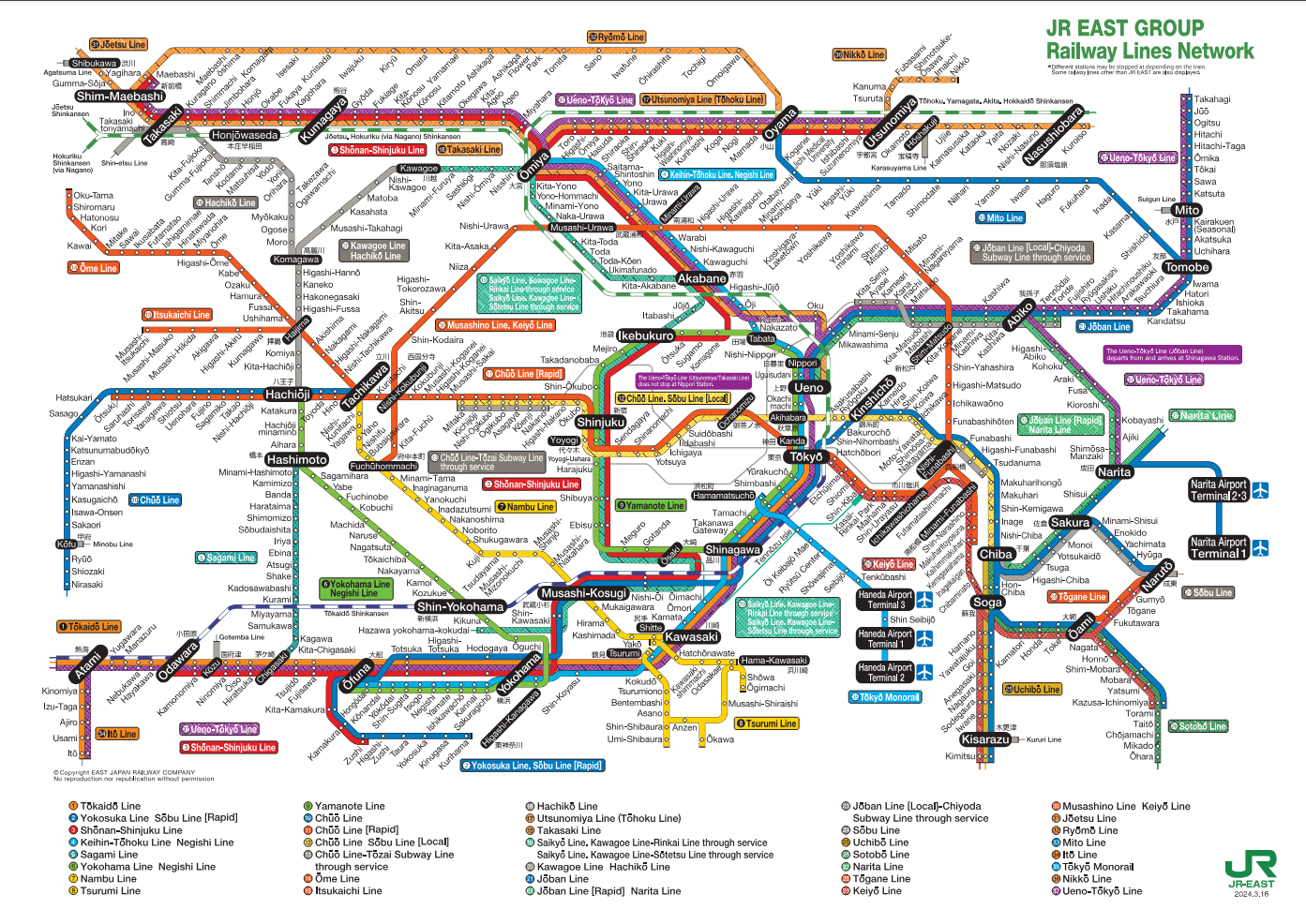
Japan Railways (JR) has the most extensive network of trains running in Tokyo. JR East is the company specifically under the JR umbrella that operates both intra-city surface trains as well as the inter-city Shinkansen (bullet trains) out of Tokyo. JR Yamanote Line in particular (a circle line) should be of interest to visitors since it connects most of the points of interests within Tokyo.
Other surface railway operators include Odakyu, Keio, Tobu, Seibu, Keisei Electric railways.
The Underground Rail network

Tokyo Metro is by far the biggest stakeholder on this network operating a total of 9 lines – Ginza, Tozai, Namboku, Marunouchi, Hibiya, Chiyoda, Yurakucho, Hanzomon & Fukutoshin lines. The other major subway operator is the Toei. There are four Toei Subway lines – Toei Asakusa, Toei Mita, Toei Shinjuku & Toei Oedo lines.
The Monorail
The Tokyo Monorail is a service that connects Hamamatsucho station with Haneda International Airport. The line is operated by JR East and takes 20 mins to get to its destination from its origin.
How to navigate the whole system
The fastest way to get to Point B from Point A is to mix and match of different lines and operators within Tokyo network. For this, you can just use Google Maps to find out which lines to take/switch to and you will be good to go. IC cards typically work best for this and Google maps also shows the cost on the journey. Just remember – changing operators means you have to swipe out of the old network and swipe into the new one, before boarding the train on another network.
Example: We stayed near the Osaki Station in Tokyo and for us, travelling to TeamLab Planets was showing this on Google Maps (fastest route)
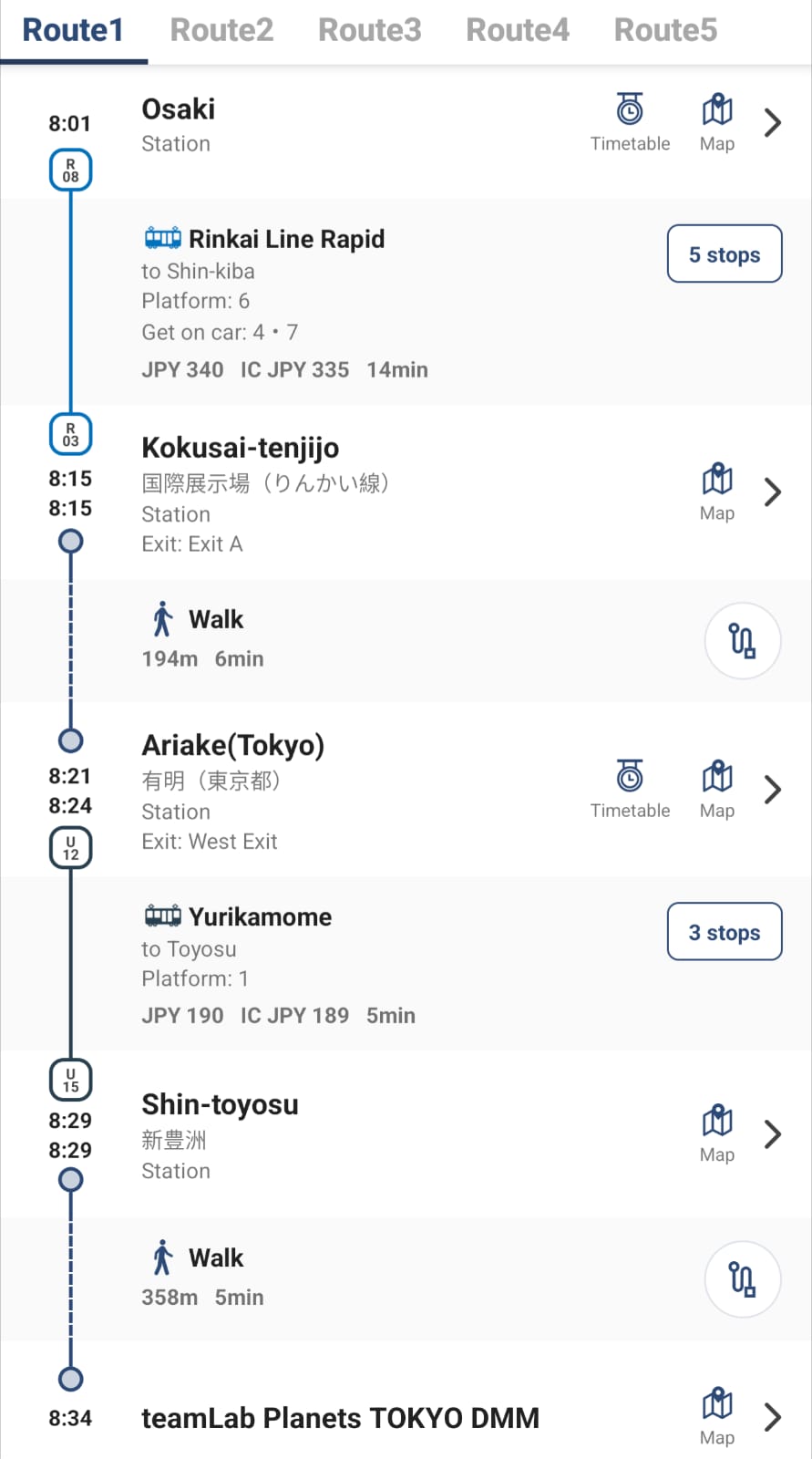
If you have a pass from JR (like JR pass, Tokyo Wide pass etc), you will have to do bit more work and bit more walking. Install an app called “Japan Travel” by Navtime which has the ability to filter out routes based on the pass you hold. For the same route above, Navtime app would give you this result.

As you can see, it involves lot more walking (even a suggested Taxi ride) and lot more convoluted route tp get to your destination. But you don’t have to pay anything extra other than the pass you have bought already (if you don’t take a taxi that is).
JR Pass vs IC card
The short answer is – It depends. If you have already bought a JR pass for 7 or 14 days thinking of inter-city commute in mind on shinkansen network and have plans to move around a lot in Japan, then the same pass with come in handy within Tokyo. But if you are still flexible to change around your itinerary, not fully convinced about the ROI on JR pass etc., we would suggest go with IC cards. They are convenient, flexible and saves you a lot of commute generally. You can also explore the 3 days JR Tokyo wide pass which covers travel to and from Kawaguchiko (for Mt Fuji). But what we generally found out was – for most of us, adding up the cost of travel on IC card still comes out cheaper than these passes.
You can find Suica and Pasmo Passport IC cards in Tokyo for purchase at Train stations and Airport. But the IC card from the Kansai region (if you are coming from Kyoto) called ICOCA works just fine. If you already have bought one in Kyoto/Osaka, no need to buy an additional one in Tokyo.
You can refer to this post to check whether a 7/14 day JR pass is worth for you.
Train Timings
Be mindful of timings of each operator, as they don’t run for 24 hours. You can get stuck in the night without a train if you miscalculate in which case you have to seek shelter wherever you are (hotel, cafe etc), or take a taxi back home which can be very expensive. Depending on where you are stuck, there may be late night buses, but do research before hand.
Note: Trains usually start service at 5 am in the morning till 11 or 12 in the night.
Final Tips
- Download the travel apps – Tokyo Subway, Japan Travel by Navtime, Google Maps etc.
- Avoid rush hour if you can – 7:30 am to 9:30 am / 5:30 pm to 7:30 pm.
- No eating allowed on intra-city rail network within Tokyo.
- There are specific coaches in each train that are stroller/wheelchair friendly with lots of standing space. Be sure to figure that out, can help you during peak times when it gets crowded.
- Just before a train stops at a station, they display station map on the screens within the train to help people locate their nearest elevator/escalator etc. Do be attentive, as this can save you precious time, when you are trying to locate an elevator for your baby stroller and yet, trying to catch the next train.
- Free wifi is available at most stations and trains.
 Unending Vacations
[…] Understanding Tokyo’s Railway network […]
LikeLike
[…] Understanding Tokyo’s Railway network […]
LikeLike